Can You Take Zopiclone Every Night? UK Safety Guide
Medical information: This guide provides general educational information. Zopiclone is a prescription-only medicine. Take it only as directed by your prescriber. Never increase the dose, add another sleeping medicine or suddenly stop regular treatment without professional advice.
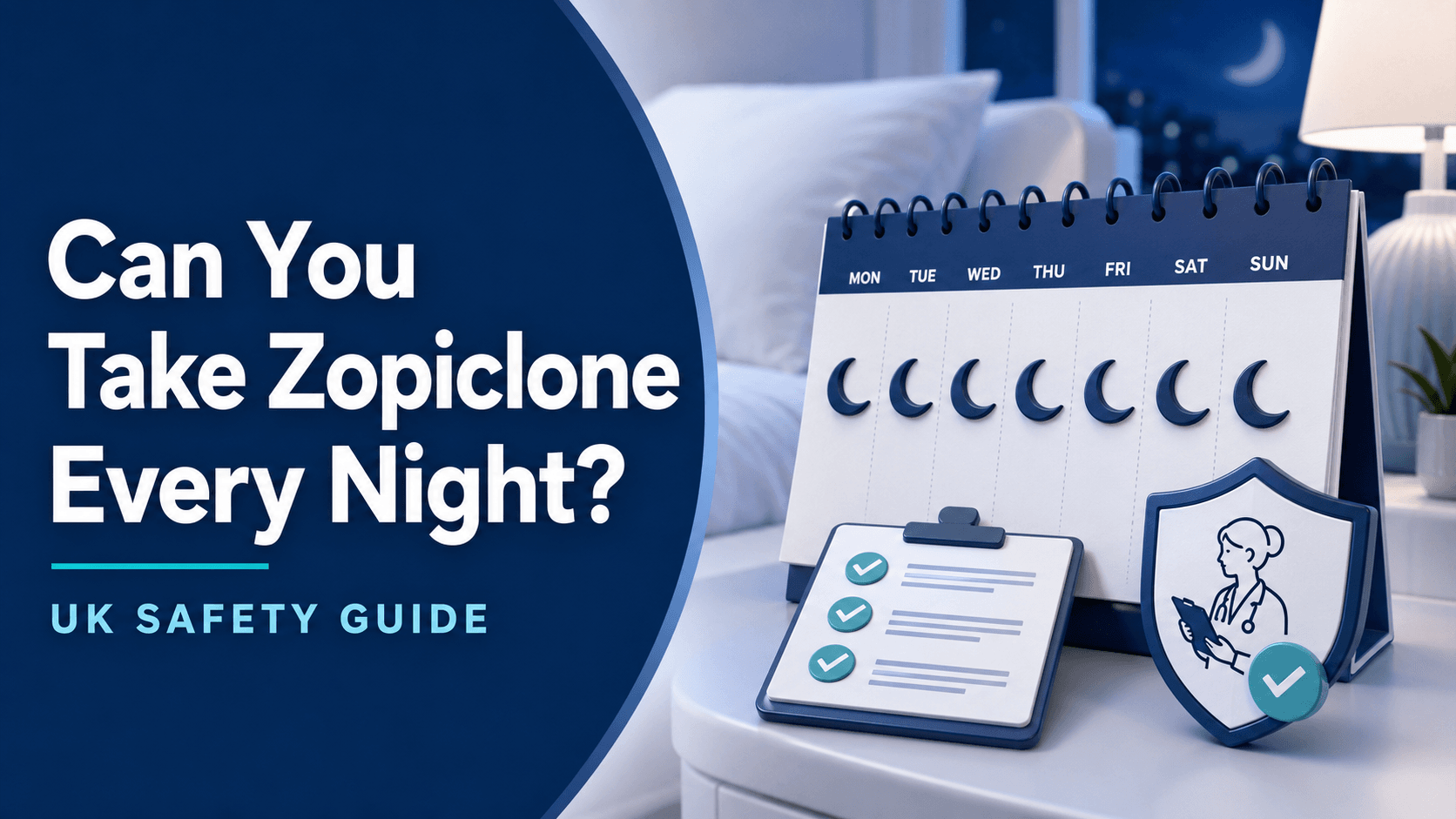
Zopiclone may be prescribed once each night during a short treatment course, but it is not generally recommended as a long-term nightly sleeping tablet.
The NHS explains that zopiclone treatment usually lasts from a few days to a few weeks. It is normally not prescribed for longer than four weeks because the body can become used to it, reducing its effect. This is known as tolerance.
If you have already been taking zopiclone every night, do not panic and do not stop suddenly. Arrange a medication review with your GP, pharmacist or prescriber. Your treatment and any dose reduction must be planned according to your individual circumstances.
Takeaways
- Zopiclone may be taken nightly when that is the short-term schedule written on your prescription.
- “Once daily at bedtime” does not mean that it is suitable for indefinite nightly use.
- Treatment commonly lasts from a few days to a few weeks.
- UK product information says treatment should normally not exceed four weeks, including gradual reduction.
- Repeated use can cause tolerance, dependence, addiction and withdrawal.
- Dependence can happen even when the medicine was originally taken as prescribed.
- Do not take a second dose during the same night.
- Do not increase from 3.75mg to 7.5mg without prescriber approval.
- Never mix zopiclone with alcohol.
- Do not stop regular or long-term use suddenly without professional advice.
- Chronic insomnia normally requires assessment and treatment beyond sleeping tablets.
Zopiclone Every Night: Quick Guide
Situation | What it means | Safer next step |
Prescribed every night for a few days | This can be part of a short treatment course | Follow the label and planned end date |
Prescribed for two or three weeks | Still considered short-term treatment | Attend any planned review and do not extend it yourself |
Approaching four weeks | Tolerance and dependence risks require attention | Ask how treatment will be reduced or stopped |
Taking it for more than four weeks | This is outside the usual treatment period | Request a full medication review |
Medicine feels less effective | Tolerance or worsening insomnia may be involved | Do not increase the dose; contact the prescriber |
Unable to sleep without it | Possible physical or psychological dependence | Discuss a personalised reduction and insomnia plan |
Experiencing symptoms after missing a dose | Withdrawal or rebound insomnia may be possible | Do not make further changes without advice |
Taking extra tablets | Overdose and impairment risks increase | Call NHS 111 after taking more than prescribed |
Mixing it with alcohol or opioids | Sedation and breathing risks can become serious | Seek urgent professional advice |
Is Zopiclone Intended to Be Taken Every Night?
Zopiclone is normally taken as a single bedtime dose when prescribed. During a short authorised course, the instructions may tell a patient to take it every night.
This does not mean that zopiclone is intended to become a permanent part of the bedtime routine.
There is an important difference between:
- frequency: how often a prescribed dose is taken; and
- duration: how many days or weeks the treatment continues.
A prescription may say to take one dose nightly, but the complete treatment may last only a few days or weeks.
Current UK product information says:
- use the lowest effective dose;
- take it as one bedtime dose;
- do not take it again during the same night;
- use it for the shortest possible period; and
- do not continue beyond four weeks, including tapering, without reassessing the patient.
Always follow the directions on your own dispensing label because the appropriate strength and duration differ between patients.
How Long Can You Take Zopiclone?
The exact treatment period must be decided by the prescriber.
Zopiclone is primarily licensed for the short-term treatment of insomnia in adults. The NHS says treatment usually lasts from a few days to a few weeks and is normally not continued beyond four weeks.
Some UK product information describes:
Type of insomnia | Example treatment period |
Temporary or transient insomnia | Approximately 2–5 days |
Short-term insomnia | Approximately 2–3 weeks |
Overall maximum treatment period | Normally no more than 4 weeks, including tapering |
These periods are general prescribing information, not a personal treatment plan.
Do not independently decide that you need treatment for the full four weeks. Some people may need only a few doses, while others may require a planned gradual reduction.
Why Is Long-Term Nightly Zopiclone Use Discouraged?
The main concerns are tolerance, dependence, withdrawal, next-day impairment and the possibility that an underlying sleep disorder remains untreated.
Tolerance Can Reduce the Effect
Tolerance means the same dose appears to produce less benefit than it did before.
You may notice that:
- it takes longer to fall asleep;
- you wake more often;
- the medicine feels weaker;
- you think about using a higher strength;
- you feel tempted to take another tablet; or
- the tablets run out sooner than expected.
One poor night does not prove tolerance. Sleep can vary because of stress, caffeine, pain, anxiety, alcohol or another health condition.
However, if zopiclone worked previously and repeatedly feels less effective, arrange a review. Read the separate guide about what to do when zopiclone is not working after that page is published.
Do not increase the dose to overcome reduced effectiveness.
Physical Dependence Can Develop
Dependence means the body has adapted to the presence of the medicine. When the dose is reduced, delayed or stopped, withdrawal symptoms may occur.
Dependence is not automatically the same as addiction. A person can become physically dependent while following their original prescription.
Risk generally increases with:
- longer treatment;
- higher doses;
- taking doses more frequently than directed;
- previous alcohol or drug dependence;
- certain mental-health conditions;
- obtaining additional supplies from different sources; and
- combining zopiclone with other sedatives.
The updated zopiclone patient leaflet warns that dependence risk increases with dose and treatment duration and is greater when treatment continues beyond four weeks.
Addiction Is Possible
Addiction may involve craving, reduced control or continuing to use the medicine despite harm.
Possible warning signs include:
- thinking frequently about the next dose;
- taking more than prescribed;
- using zopiclone during the day;
- hiding how much is being taken;
- repeatedly requesting early supplies;
- visiting multiple prescribers or sellers;
- feeling unable to cope without the medicine;
- unsuccessful attempts to reduce use; and
- continuing despite falls, memory problems or unsafe daytime sleepiness.
The MHRA strengthened warnings in January 2026 about addiction, dependence, tolerance and withdrawal associated with Z-drugs.
These risks are health problems, not personal failures. Honest information helps a prescriber develop a safer treatment plan.
Withdrawal and Rebound Insomnia
Suddenly stopping regular zopiclone can cause withdrawal symptoms. Sleep may also temporarily become worse than it was before treatment. This is called rebound insomnia.
Possible withdrawal symptoms include:
- anxiety;
- agitation;
- restlessness;
- sweating;
- shaking;
- headaches;
- palpitations;
- nightmares;
- confusion;
- nausea;
- muscle discomfort; and
- severe sleep disruption.
The NHS advises patients not to stop zopiclone suddenly. A doctor may gradually reduce the dose so treatment can be stopped more safely.
NICE guidance on dependence-forming medicines also recommends an individual reduction plan rather than an abrupt or fixed approach.
There is no single online tapering schedule that is appropriate for everyone. The plan may depend on:
- the current dose;
- total treatment duration;
- frequency of use;
- previous withdrawal symptoms;
- other medicines;
- physical and mental health;
- alcohol or substance use; and
- the patient’s response to each reduction.
Do not copy another person’s reduction schedule.
Nightly Use and Next-Day Impairment
Taking zopiclone at night can still affect alertness the following day.
Common effects include:
- sleepiness;
- feeling dazed;
- dizziness;
- reduced concentration;
- slower reactions;
- poor balance;
- bitter or metallic taste; and
- dry mouth.
The NHS advises not driving, cycling or operating machinery for 12 hours after taking zopiclone. Even after 12 hours, do not drive or complete safety-critical work if you remain sleepy, confused, dizzy or less alert.
Nightly impairment can be particularly important for:
- professional drivers;
- machine operators;
- construction workers;
- people working at height;
- healthcare workers;
- carers;
- parents responsible for young children;
- students sitting examinations; and
- older adults at increased risk of falls.
Next-day impairment deserves a medication review even when zopiclone is still helping with sleep.
Complex Sleep Behaviours
Zopiclone can rarely be associated with activities performed while the person is not fully awake.
Examples can include:
- sleepwalking;
- preparing or eating food;
- making telephone calls;
- leaving the house;
- driving; or
- other behaviour that the person cannot remember later.
The UK patient leaflet advises that people who previously experienced complex sleep behaviour after zopiclone should not take it again unless appropriately reviewed.
Stop and obtain prompt medical advice before another dose if sleepwalking or another unusual sleep behaviour occurs.
Alcohol, Opioids and Other Sedatives
Do not drink alcohol while taking zopiclone.
Alcohol can increase sedation, worsen coordination, affect breathing and make someone difficult to wake.
Particular caution is also required with:
- codeine;
- tramadol;
- morphine;
- oxycodone;
- benzodiazepines;
- other sleeping tablets;
- sedating antihistamines;
- some antidepressants;
- antipsychotic medicines;
- pregabalin;
- gabapentin; and
- recreational substances.
The zopiclone patient leaflet warns that combining it with opioids can increase the risk of drowsiness, breathing difficulty, coma and death.
Tell the prescriber about every prescription medicine, pharmacy product, supplement, herbal remedy and recreational substance you use.
Do not add another sleep product because your usual zopiclone dose appears less effective.
Can a Doctor Ever Prescribe Zopiclone for Longer?
Some patients do use zopiclone beyond the normal short-term period, but this should not happen automatically.
UK product information says extension beyond the maximum period should not occur without re-evaluation of the patient’s condition.
A responsible review should consider:
- why insomnia continues;
- whether zopiclone is still providing meaningful benefit;
- daytime side effects;
- signs of tolerance;
- dependence or withdrawal;
- dose escalation;
- other medicines;
- alcohol use;
- breathing problems;
- falls or memory problems;
- mental health;
- safer treatment options; and
- how treatment will eventually be reduced.
A repeat prescription is not proof that indefinite use is risk-free. Continued prescribing should involve a documented clinical reason and ongoing review.
Read how the zopiclone prescription process works in the UK.
What Should You Do If You Already Take Zopiclone Every Night?
Do not stop suddenly or make a large dose reduction without advice.
Follow these practical steps.
1. Record Your Current Use
Write down:
- your prescribed strength;
- the actual amount taken;
- how many nights per week you use it;
- how long you have taken it;
- whether the dose has changed;
- when you last received a prescription;
- whether tablets run out early; and
- what happens when a dose is missed.
Give accurate information even if your use has gone beyond the original instructions.
2. Record the Current Sleep Problem
Note whether you:
- struggle to fall asleep;
- wake repeatedly;
- wake too early;
- sleep but remain exhausted;
- snore or stop breathing;
- experience restless legs;
- have nightmares;
- work changing shifts; or
- feel anxious at bedtime.
A sleep diary can help distinguish medicine-related problems from an untreated sleep condition.
3. List Other Medicines and Substances
Include:
- prescription medicines;
- pharmacy products;
- supplements;
- herbal remedies;
- caffeine;
- nicotine;
- alcohol; and
- recreational substances.
Do not leave out another sedative because you are worried about criticism. That information can be essential for preventing a dangerous interaction.
4. Arrange a Medication Review
Speak with your GP, pharmacist or original prescriber.
Useful questions include:
- Why am I still taking zopiclone?
- Is it still helping enough to justify the risks?
- Have I developed tolerance or dependence?
- Could another medicine be affecting my sleep?
- Do my symptoms suggest sleep apnoea or another sleep disorder?
- Should the dose remain the same until a reduction plan is prepared?
- What support will be provided during reduction?
- Could CBT-I help with my long-term insomnia?
5. Follow an Individual Plan
The plan may involve:
- continuing the current dose temporarily;
- making gradual reductions;
- slowing or pausing reductions if withdrawal is difficult;
- treating anxiety, pain or depression;
- screening for another sleep disorder;
- using CBT-I; or
- reviewing another medicine that disrupts sleep.
The correct plan cannot be selected from a general article.
What Not to Do
If you are taking zopiclone every night, avoid these common mistakes:
- Do not take an extra tablet during the night.
Zopiclone should be taken as a single bedtime dose. - Do not increase the strength yourself.
Moving from 3.75mg to 7.5mg requires prescriber approval. - Do not use alcohol to strengthen the effect.
This can cause dangerous sedation and breathing problems. - Do not add another sleeping medicine.
Combining sedatives can increase impairment and overdose risk. - Do not suddenly stop after regular use.
Withdrawal and rebound insomnia may occur. - Do not use someone else’s prescription.
Their dose and medical risks may be different. - Do not obtain additional tablets from an unregulated seller.
The product may be counterfeit, contaminated or incorrectly labelled. - Do not hide dose changes from the prescriber.
Accurate information is necessary for a safe plan.
Treating Long-Term Insomnia
Zopiclone provides temporary sleep support. It does not permanently remove every cause of insomnia.
Long-term sleep problems may be connected with:
- anxiety;
- depression;
- chronic pain;
- menopause;
- sleep apnoea;
- restless legs;
- shift work;
- caffeine;
- nicotine;
- alcohol;
- another medicine;
- an irregular sleep schedule; or
- sleep-related worry.
For chronic insomnia, NICE recommends CBT-I as the first-line treatment for adults.
CBT-I can include:
- controlling the time spent awake in bed;
- rebuilding the connection between bed and sleep;
- keeping a consistent wake-up time;
- adjusting unhelpful beliefs about sleep;
- reducing bedtime monitoring and anxiety;
- relaxation strategies; and
- a structured sleep plan.
Basic sleep habits can support treatment, but chronic insomnia may require more than general sleep-hygiene advice.
You can also review these non-medicine approaches to insomnia.
When Should You Seek Medical Help?
Arrange a prompt medication review if:
- you have taken zopiclone every night for several weeks;
- treatment has continued beyond the planned end date;
- the medicine has become less effective;
- you feel that you need a higher dose;
- tablets run out early;
- you cannot sleep without it;
- you experience symptoms after missing a dose;
- you have daytime sleepiness or confusion;
- you have fallen;
- you take opioids or another sedative;
- you snore, choke or stop breathing during sleep; or
- insomnia has continued for months.
Call NHS 111 if you have taken more than your prescribed dose, even if you currently feel well.
Call 999 if someone:
- has collapsed;
- is unconscious;
- is extremely difficult to wake;
- has severe breathing difficulty;
- has a seizure; or
- has intentionally taken an overdose.
Do not drive yourself to hospital after taking an extra dose.
Frequently Asked Questions
Can you take zopiclone every night?
Zopiclone may be prescribed every night during a short treatment course. It is not generally recommended for indefinite nightly use because tolerance, dependence and withdrawal can develop.
How many nights in a row can you take zopiclone?
Follow the exact duration written on your prescription. Treatment often lasts from a few days to a few weeks and normally should not exceed four weeks, including tapering, without clinical re-evaluation.
Can I take zopiclone every night for a week?
A one-week course may be prescribed for some adults with severe short-term insomnia. Take it only when this matches your prescription instructions.
Can I take zopiclone every night for a month?
Four weeks is normally the maximum overall treatment period described in UK product information, including dose reduction. Do not automatically continue for a complete month unless that is your authorised plan.
What happens if you take zopiclone every night?
Possible effects include reduced effectiveness, dependence, withdrawal risk, next-day drowsiness, poor concentration and psychological reliance on the medicine for sleep.
Does nightly zopiclone always cause addiction?
No. Not everyone becomes addicted. However, regular use can cause physical dependence, and risk generally increases with dose and duration.
How quickly does zopiclone tolerance develop?
There is no exact timeline for every person. The NHS warns that the body can become used to zopiclone during treatment, which is one reason prescriptions are normally kept short.
Can I take breaks from zopiclone?
Do not create your own alternating or “drug holiday” schedule. Sudden gaps after regular use may cause withdrawal or rebound insomnia. Ask your prescriber how doses should be changed.
Can I stop after taking zopiclone for two weeks?
Some people may be able to finish a short course as directed, while others may need gradual reduction. Follow the plan supplied with your prescription and ask the prescriber if you are uncertain.
Can I take half a zopiclone tablet instead?
Do not split a tablet unless your exact product can be divided and your prescriber or pharmacist has confirmed the intended dose.
What if zopiclone no longer helps me sleep?
Do not take an additional tablet or increase the strength. Reduced effect may indicate tolerance, an interaction or an untreated cause of insomnia. Arrange a medication review.
Is long-term zopiclone use safe for older adults?
Older or frail adults may be more sensitive to sedation, confusion, poor balance and falls. Long-term nightly treatment requires careful individual review.
Conclusion
Zopiclone may be taken every night when it has been prescribed as part of a short, clearly defined course. That does not make it a suitable permanent sleep treatment.
UK guidance normally limits treatment to a few days or weeks and generally no more than four weeks, including tapering. Longer treatment requires clinical re-evaluation because tolerance, dependence, withdrawal and next-day impairment can occur.
If you already take zopiclone every night, do not increase the dose or suddenly stop. Record your current use and sleep pattern, then request a medication review.
The long-term goal should be to identify and treat the cause of insomnia while reducing reliance on a short-term sleeping medicine as safely as possible.