How Long Does Zopiclone Take to Work UK Guide
According to the current UK Summary of Product Characteristics (SmPC) published through the electronic Medicines Compendium (eMC), Zopiclone has an elimination half-life of approximately five hours in many adults. Its half-life may increase to around seven hours in some older adults. Based on these figures, most of a single dose may take roughly 20 to 35 hours to be eliminated, but this is only a general estimate—not an exact personal clearance time.
When someone asks how long does Zopiclone stay in your system, they may be asking about three different things: how long its sedating effect lasts, how long the body takes to process it, or how long a laboratory test might detect it. These are not interchangeable. Feeling awake does not prove that the medicine has completely left the body, and half-life cannot guarantee the result of a drug test.
Zopiclone Duration at a Glance
| Question | General explanation |
|---|---|
| Average elimination half-life | Approximately five hours in many adults |
| Half-life in some older adults | Approximately seven hours |
| Estimated time for most of one dose to be removed | Roughly 20 to 35 hours, with individual variation |
| Next-day effects | Possible even after waking, especially when sleep time is short or clearance is slower |
| Laboratory detection | Depends on the test, sample, timing and individual; half-life alone cannot predict it |
The table gives educational estimates. It must not be used to decide when it is safe to drive, operate machinery, take another sedative or change a prescribed dose.
What Does “Stay in Your System” Mean?
Duration of noticeable effects
Zopiclone is prescribed for short-term treatment of severe insomnia in suitable adults. Its most noticeable sleep-related effect usually reduces before every trace has been eliminated. Some people may still experience next-day sleepiness, dizziness, reduced concentration, poor coordination or slower reactions.
Elimination from the body
Elimination describes how the body metabolises and removes a medicine. The UK eMC SmPC explains that Zopiclone is cleared mainly through metabolism. It is extensively converted into two principal metabolites, with most eliminated material leaving through urine as metabolites and a smaller proportion through faeces.
Detection by a laboratory test
A detection window is not the same as a half-life or duration of sedation. Results can vary according to whether blood, urine, saliva or hair is tested, the sensitivity of the method, the timing of the sample, the dose pattern and individual physiology. Anyone facing medical, workplace or legal testing should follow the instructions of the organisation conducting the test. This article does not promise a negative result after a particular number of hours.
What Is the Half-Life of Zopiclone?
The Zopiclone half-life is approximately five hours in many adults. Half-life is the estimated time needed for the amount in the body to reduce by half. It does not mean that the medicine disappears completely after five hours.
A simplified five-hour example helps explain the process:
- After about five hours, approximately one-half may remain.
- After about ten hours, approximately one-quarter may remain.
- After about fifteen hours, approximately one-eighth may remain.
- After about twenty hours, approximately one-sixteenth may remain.
- After about twenty-five hours, only a small proportion may remain.
This is a mathematical illustration, not a personalised medical prediction. Human metabolism varies, and the remaining amount does not directly show how sleepy or alert a person will feel.
How Long Does Zopiclone Stay in Your Body?
Using approximately four to seven half-lives as a broad illustration, most of a single dose may take around 20 to 35 hours to be removed. Therefore, the answer to how long does Zopiclone stay in your body can be about one day or longer even when the strongest sleep-inducing effect has already ended.
This estimate should never be used to plan an extra dose. The official UK Patient Information Leaflet (PIL) instructs patients to take Zopiclone as a single bedtime dose and not take it again during the same night. If a dose is missed at bedtime, it should not be taken later to make up for it.
The separate question of onset belongs to another page. Read how long Zopiclone takes to work without changing this article’s duration and half-life focus.
What Can Affect Zopiclone Clearance Time?
Age
Current UK eMC product information reports that the elimination half-life may lengthen to approximately seven hours in older adults. Older people may also be more sensitive to confusion, impaired balance, excessive sedation and falls. A prescriber considers age, general health and current medicines when deciding whether treatment and a particular strength are suitable.
Liver function
The liver has an important role in Zopiclone metabolism. The UK SmPC states that plasma clearance is reduced in people with cirrhosis because metabolism is slower. Liver disease can therefore affect suitability and dosing. A person with liver problems should not adjust treatment without clinical advice.
Other medicines
The current UK PIL warns that several medicines can increase sedation or alter how Zopiclone works. These include opioids, other hypnotics or anxiety medicines, sedating antihistamines, some antidepressants, antipsychotics, epilepsy medicines, and certain antibiotics or antifungals. A prescriber needs a complete list of prescription medicines, pharmacy products and herbal remedies before assessing suitability.
Alcohol and other sedatives
The NHS and the UK PIL advise against drinking alcohol while taking Zopiclone. Alcohol can intensify sedation and may cause very deep sleep, breathing difficulty or difficulty waking. Other central nervous system depressants can also increase impairment. Read the internal guide to Zopiclone and alcohol for focused safety information.
Timing and available sleep
Taking a prescribed dose late and waking early leaves less time for its effects to reduce. The UK PIL advises allowing seven to eight hours of uninterrupted sleep. A person may therefore feel impaired the next morning even if the same prescribed dose previously caused no obvious daytime effect.
Can Zopiclone Affect You the Next Day?
Yes. Possible next-day effects include drowsiness, dizziness, impaired memory, slower thinking, reduced concentration and poor coordination. The absence of obvious sleepiness is not proof that psychomotor performance has fully returned to normal.
The current UK Patient Information Leaflet states that activities requiring complete mental alertness—particularly driving or operating machinery—should be avoided during the 12 hours after taking Zopiclone. A person must also not drive after that period if still sleepy, dizzy, confused, less alert or otherwise impaired. GOV.UK guidance confirms that driving while impaired by a medicine is unlawful.
For more detail about unwanted effects, read the Zopiclone side-effects guide.
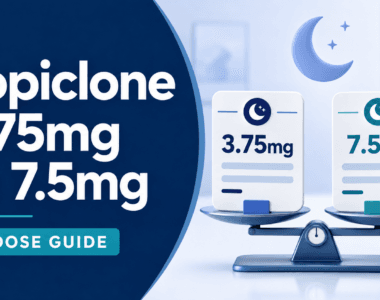
Does 3.75mg Leave the Body Faster Than 7.5mg?
A 3.75mg tablet contains less active medicine than a 7.5mg tablet, but that does not provide a guaranteed personal clearance time. The UK eMC SmPC states that plasma clearance across the described dose range is not dose-dependent. Age, liver function, medicine interactions and individual sensitivity still matter.
Strength must not be selected by comparing half-life estimates. The appropriate dose is a clinical decision based on symptoms, age, health, current medicines and the risk of excessive sedation. Do not split, combine or switch tablets unless the prescriber has given clear directions.
Repeated Use, Dependence and Withdrawal
The UK SmPC does not generally report significant accumulation after repeated administration in suitable patients. However, lack of accumulation does not mean that longer use is safe. The current UK PIL warns that the risk of dependence rises with the dose and duration of treatment. Zopiclone is normally intended for short-term use, and the full course—including any reduction period—should generally not exceed four weeks unless a prescriber has made an individual decision.
Do not increase the dose if the effect seems weaker. A person who has used Zopiclone regularly should not stop suddenly without medical advice because withdrawal and rebound insomnia may occur. The prescriber can provide an individual reduction plan.
When to Seek Medical Help
Contact NHS 111 for urgent advice if more than the prescribed dose has been taken, Zopiclone has been combined with alcohol or opioids, or concerning symptoms develop. Call 999 if someone is difficult to wake, has severe breathing difficulty, collapses, has a seizure or appears to be in immediate danger. Do not make the person vomit unless a healthcare professional instructs you to do so.
Summary
How long does Zopiclone stay in your system? Current UK eMC product information gives an elimination half-life of approximately five hours in many adults and around seven hours in some older adults. Most of one dose may therefore take roughly 20 to 35 hours to be removed, but the noticeable effect, complete elimination, next-day impairment and laboratory detection are different measures. Age, liver function, other medicines, alcohol and available sleep time can change the experience. Follow the prescription and seek professional advice when effects are stronger or last longer than expected.
Frequently Asked Questions
How long does Zopiclone stay in your system after one dose?
Most of one dose may take roughly 20 to 35 hours to be eliminated based on an approximate five-hour half-life. This is a general estimate, not an exact personal timetable.
What is the half-life of Zopiclone 7.5mg?
The UK eMC SmPC gives an elimination half-life of approximately five hours in many adults. It may increase to around seven hours in some older adults.
Can Zopiclone affect you the next morning?
Yes. Next-day drowsiness, dizziness, slower reactions and reduced concentration can occur. The UK PIL advises avoiding driving and other hazardous activities requiring full alertness during the 12 hours after taking it.
Does feeling awake mean Zopiclone has left the body?
No. The noticeable sedating effect can reduce before the medicine has been fully eliminated. Feeling awake cannot confirm that driving or another safety-sensitive activity is safe.
Does Zopiclone remain longer in older adults?
It can. UK product information reports that the half-life may increase from approximately five hours to around seven hours in some older adults.
Can alcohol make Zopiclone effects last longer?
Alcohol can greatly intensify sedation and increase the risk of breathing difficulty, very deep sleep and difficulty waking. NHS and UK PIL guidance says not to drink alcohol while taking Zopiclone.
Should I take another tablet if the first one has not worked?
No extra or repeat dose should be taken during the same night. Follow the prescription and contact the prescriber or pharmacist if the treatment is not working as expected.
Is a drug-test window the same as the Zopiclone half-life?
No. Detection depends on the test, sample, sensitivity, dose pattern, timing and individual. Half-life alone cannot guarantee when a test will become negative.
Prescription-Only Medicine (POM): Zopiclone is available only with a valid prescription.
A qualified UK prescriber must assess symptoms, medical history, current medicines and clinical suitability.
Zopiclone is intended for short-term use in suitable adults and may cause drowsiness, tolerance, dependence and withdrawal.
Do not mix Zopiclone with alcohol, take more than prescribed, share it, or drive when impaired.
Approval, dispensing, availability and delivery are not guaranteed and depend on a lawful clinical and pharmacy process.