Diazepam Prescription Requirements UK: What You Need to Know
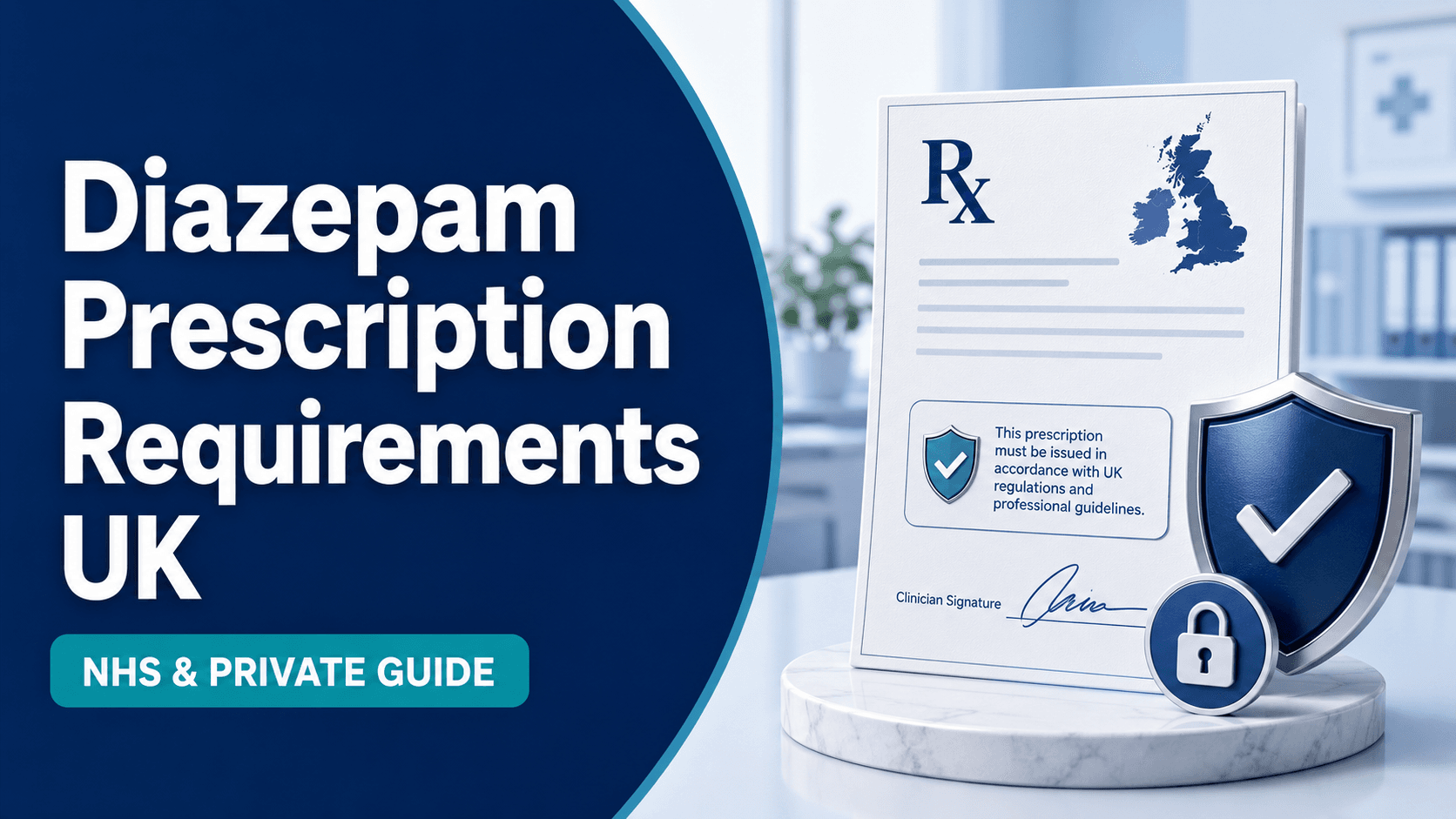
Diazepam prescription requirements UK searches often ask whether the medicine is available through the NHS or a private doctor and which controlled-drug rules apply. Diazepam is a prescription-only medicine and a Class C, Schedule 4 Part I controlled drug.
A prescription is never automatic. A qualified prescriber must decide that treatment is appropriate after reviewing the condition, medical history, medicines and safety risks. This guide explains the NHS and private routes, legal classification, dispensing rules and common reasons a request may be declined.
Answer
The central diazepam prescription requirements UK rule is simple: a person needs a valid prescription from an appropriately qualified, legally authorised prescriber. Diazepam cannot be supplied as an ordinary over-the-counter medicine.
In the UK, diazepam is:
- a prescription-only medicine
- a benzodiazepine
- a Class C controlled drug
- listed in Schedule 4 Part I of the Misuse of Drugs Regulations; and
- normally prescribed for the shortest appropriate period.
Schedule 4 does not mean that every special writing rule for Schedule 2 or 3 controlled drugs applies. A Schedule 4 prescription is generally valid for 28 days, and lawful possession still depends on legal supply.
Diazepam Prescription Requirements UK at a Glance
Question | UK answer |
Is diazepam prescription-only? | Yes. It is not an over-the-counter medicine. |
Is diazepam controlled? | Yes. It is a Class C controlled drug. |
What schedule is diazepam? | Schedule 4 Part I under the Misuse of Drugs Regulations. |
Does a consultation guarantee a prescription? | No. The prescriber may decline or recommend another treatment. |
Can an NHS clinician prescribe it? | Yes, when clinically appropriate and within relevant guidance and local policy. |
Can a private doctor prescribe it? | A legally authorised private prescriber may prescribe it when clinically justified, but many services restrict or exclude benzodiazepines. |
How long is the prescription valid? | A Schedule 4 controlled-drug prescription generally must be dispensed within 28 days of the appropriate date. |
Is long-term treatment routine? | No. Diazepam is normally used short term, although some conditions need specialist-led plans. |
Is Valium different from diazepam? | Valium is a brand name for diazepam. UK prescriptions commonly use the generic name. |
What Is Diazepam?
Diazepam is a long-acting benzodiazepine that strengthens calming GABA activity in the brain. It may be used for severe short-term anxiety, muscle spasm, certain seizures, supervised acute alcohol withdrawal or selected procedural sedation.
Its effects can also reduce alertness, memory, balance and reaction time. It is not a routine answer to everyday stress or occasional poor sleep. Read the broader diazepam 10mg UK safety guide for its uses, limits and risks.
Does Diazepam Require a Prescription in the UK?
Yes. Diazepam is a prescription-only medicine. A pharmacy should supply it only through a lawful prescription or another legally authorised clinical route.
A valid prescription confirms that an authorised prescriber has taken responsibility for the treatment decision. It does not simply prove that someone completed an online form or paid a consultation fee. The prescriber must have enough reliable information to decide whether the medicine is needed, whether the expected benefit outweighs the risks, and whether safe monitoring can be arranged.
Someone else’s prescription cannot be used. Tablets prescribed to one person should never be shared, sold or given to another person.
Is Diazepam a Controlled Drug?
Yes. Diazepam controlled-drug status has two parts that are often confused:
- Under the Misuse of Drugs Act, diazepam is a Class C drug.
- Under the Misuse of Drugs Regulations, it is placed in Schedule 4 Part I.
The class mainly relates to legal control and offences involving unlawful possession or supply. The schedule explains how the medicine is managed in legitimate healthcare and pharmacy settings.
People sometimes copy US information that calls diazepam “Schedule IV.” The UK also uses Schedule 4, but it comes from different legislation and should not be explained through American rules.
What Schedule Is Diazepam?
Diazepam is a Schedule 4 Part I controlled drug in the UK. Part I includes many benzodiazepines.
Schedule 4 carries lighter professional controls than Schedule 2 or Schedule 3. The special controlled-drug prescription-writing requirements in Regulation 15 do not apply to Schedule 4 Part I in the same way. Schedule 4 medicines are also generally exempt from controlled-drug register and safe-custody requirements that apply to higher schedules in many healthcare settings.
This does not make diazepam an ordinary medicine. It remains prescription-only, controlled and associated with misuse, dependence and diversion risks.
Class C and Schedule 4: What Is the Difference?
Term | What it describes | What it means for diazepam |
Prescription-only medicine | How a human medicine may be supplied | A valid prescription or other lawful clinical authority is required. |
Class C | Classification under the Misuse of Drugs Act | Unlawful possession and supply can be criminal offences. |
Schedule 4 Part I | Healthcare controls under the Misuse of Drugs Regulations | Lighter controls than Schedules 2 and 3, but prescription validity and other legal rules still apply. |
This distinction is important because saying only “diazepam is controlled” does not explain which rules actually apply.
What Must Happen Before Diazepam Can Be Prescribed?
The diazepam prescription requirements UK process is based on clinical need rather than a customer request. A responsible assessment will usually consider:
- the main symptoms and when they began
- their severity and effect on daily life
- the condition, previous treatment and relevant records
- medicines, supplements, allergies and reactions
- alcohol, opioid or recreational-drug use
- previous benzodiazepine use, dependence or withdrawal
- breathing, liver, frailty, falls and memory risks
- mental health and safeguarding concerns
- pregnancy or breastfeeding; and
- whether safe follow-up is possible.
The pathway varies by condition. A seizure emergency, acute alcohol withdrawal, muscle spasm and severe anxiety require different assessments.
Who Can Prescribe Diazepam?
Diazepam must be prescribed by a legally authorised healthcare professional who is working within their competence and has enough information to make a safe decision. This may be a doctor or another qualified independent prescriber whose scope covers the medicine and condition. A dentist may prescribe it for a genuine dental need.
A professional does not have to prescribe merely because a patient, airline, employer or another service requests it. The dispensing pharmacist must also be satisfied that the prescription is lawful and appropriate.
Getting Diazepam on an NHS Prescription
An NHS prescriber may issue diazepam when it is clinically appropriate, but UK guidance is cautious. For anxiety, benzodiazepines are not normally routine long-term treatment; they may sometimes be used briefly during a severe crisis.
Some GP practices do not prescribe diazepam for flying, routine MRI anxiety or dental procedures. A clinician may decide that the risk outweighs the benefit or that the team performing the procedure should manage sedation. Explain the symptoms and situation rather than demanding a named medicine.
Can You Get a Private Prescription for Diazepam?
A private prescription for diazepam is possible when an authorised private prescriber decides that it is clinically justified. The patient normally pays for the consultation, medicine and dispensing charge.
Private care does not bypass safety checks. The prescriber should confirm identity, obtain an adequate history, review medicines and records where needed, assess interaction and dependence risks, and arrange follow-up. Many private or online services do not prescribe benzodiazepines. Paying for an appointment never guarantees a prescription.
Will a Private Doctor Prescribe Diazepam?
A private doctor may prescribe diazepam, but only after making an independent decision. They may decline if the proposed use is unsuitable, records cannot be checked, safer options have not been considered, another sedative is already prescribed, or there are breathing, overdose, dependence or monitoring concerns.
An NHS GP is not required to convert a private prescription into an NHS prescription. The NHS clinician must make their own assessment and may recommend a different plan.
Can Diazepam Be Prescribed After an Online Consultation?
Remote prescribing can be lawful, but the same professional duties apply. The clinician must be able to verify identity, understand the symptoms, review relevant medicine history, assess safeguarding and misuse risks, and arrange monitoring. A questionnaire alone may not be enough for a controlled, dependence-forming medicine.
Avoid websites that promise diazepam without a prescription, guarantee approval, sell tablets before assessment or fail to identify the prescriber and pharmacy.
What Conditions Might Diazepam Be Prescribed For?
Diazepam may be used in selected cases of severe short-term anxiety, acute muscle spasm, certain seizures, supervised acute alcohol withdrawal, cerebral spasticity or procedural sedation. The indication determines who should manage treatment and what monitoring is required. Seizures and acute alcohol withdrawal can be emergencies and should not be self-managed.
Diazepam may cause sleepiness, but it is not a general-purpose sleeping tablet. If anxiety is disrupting rest, review this guide to anxiety and sleep problems rather than treating every bad night with a sedative.
Why Might a Diazepam Request Be Refused?
A refusal does not necessarily mean that the symptoms are not real. It usually means the clinician believes diazepam is not the safest or most appropriate response.
Common reasons include:
- the symptoms or proposed use do not support treatment
- local policy recommends another pathway
- opioids, alcohol or other sedatives create an unsafe combination
- breathing problems, liver disease, pregnancy, frailty or falls increase risk
- records suggest duplication, early use or dependence; or
- more assessment, monitoring or specialist input is needed.
Ask what alternative treatment, referral or safety plan is recommended. Do not respond by buying from an unregulated seller.
Fear of Flying, MRI Scans and Dental Procedures
Many UK GP practices do not prescribe diazepam for fear of flying because of impaired reactions, poor coordination, emergency-response concerns, alcohol interaction and dependence risk. For MRI or dental anxiety, the team performing the procedure may need to assess and manage sedation. A GP refusal does not mean a private prescription will be available.
How Long Is a Diazepam Prescription Valid?
A Schedule 4 controlled-drug prescription generally must be dispensed within 28 days of its appropriate date. This may be the signing date or a later date specified by the prescriber.
That deadline is not a guaranteed 28-day treatment course. Quantity and duration depend on the clinical plan, and controlled-drug quantities should not normally exceed 30 days without a reason. For anxiety, diazepam is generally used for the shortest possible time; follow the duration on the label rather than treating four weeks as a target.
Does a Private Diazepam Prescription Need a Special Controlled-Drug Form?
The special private controlled-drug forms and Regulation 15 writing rules commonly discussed in England mainly concern Schedule 2 and Schedule 3 medicines. Diazepam is Schedule 4 Part I, so those stricter rules do not apply in the same way.
The prescription must still meet the general legal requirements for a prescription-only medicine. Administrative rules differ across the four UK nations, so a local pharmacy can confirm what is needed.
What Happens at the Pharmacy?
The pharmacist checks the prescription, patient details, dose and interactions, and may contact the prescriber. Allow time before the 28-day deadline in case stock or a query must be resolved.
Valium in the UK
Valium is a brand name for diazepam. The name does not change the law: branded and generic diazepam require a prescription and carry the same core risks. “Valium” advertised online should not be assumed genuine; counterfeit tablets may contain the wrong amount or a dangerous undeclared substance.
Diazepam Safety Checks
The prescription decision must account for several major risks:
- Alcohol and sedatives: alcohol, opioids, sleeping tablets and other sedating medicines can increase drowsiness, poor coordination and breathing problems.
- Driving: do not drive if sleepy, dizzy, confused, weak or less alert. Prescribed use is not a defence when driving is impaired or the medicine was not taken as directed.
- Age and frailty: older or frail people may be more sensitive to confusion, falls and prolonged sedation.
- Breathing and liver health: sleep apnoea, severe respiratory disease or severe liver problems may make diazepam unsuitable.
Dependence, Tolerance and Withdrawal
Diazepam can cause tolerance, physical dependence, addiction and withdrawal. The MHRA strengthened UK benzodiazepine warnings in 2026 because these problems may occur during prolonged treatment and sometimes during short-term use at recommended doses.
Warning signs include needing more for the same effect, taking it more often, running out early, seeking several prescribers, combining sedatives or feeling unable to cope without it. Anxiety, shaking or severe sleep problems after a missed dose may indicate withdrawal.
Do not suddenly stop regular treatment. Withdrawal can be serious and may include seizures; ask for an individual reduction plan.
What Should You Do If Diazepam Does Not Work as Expected?
Do not take an extra dose, increase the strength or add another sedative. Response varies with the condition, timing, food, other medicines and individual health.
Keep a record of when the prescribed dose was taken, the symptom being treated, benefit, side effects and any next-day impairment. Then contact the prescriber or pharmacist. The guide on how long diazepam takes to work explains why taking another tablet too early can be dangerous.
Safer Long-Term Management
Diazepam may temporarily reduce a symptom without treating every underlying cause. Longer-term anxiety care may involve psychological therapy, guided self-help, treatment of mental or physical-health causes, and another medicine when appropriate. Persistent sleep problems may require structured insomnia treatment.
If diazepam is being compared with another benzodiazepine, do not use milligram numbers as a conversion. Different medicines have different properties. The Xanax vs diazepam comparison explains why switching should be prescriber-led.
Regular sedative use should be reviewed. Read about the risks of relying on sleeping tablets nightly if sleep medicines have become a nightly routine.
When Should You Seek Medical Help?
Arrange a prompt review if:
- treatment has continued beyond the planned end date
- the medicine feels less effective or a higher dose seems necessary
- tablets run out early or missed doses cause symptoms
- there is severe daytime drowsiness, confusion or a fall
- alcohol, opioids or another sedative is being used
- breathing pauses, choking, mood deterioration or suicidal thoughts occur; or
- more than one prescriber is involved.
Call NHS 111 if more than the prescribed dose has been taken, even if the person currently feels well.
Call 999 if someone has collapsed, is unconscious, has severe breathing difficulty, has a seizure or cannot be woken. Do not drive yourself to hospital after taking extra diazepam.
Frequently Asked Questions
What are the diazepam prescription requirements UK patients should know?
A valid prescription from an authorised prescriber is required. The clinician must decide that diazepam is appropriate after assessing the condition, medical history, current medicines, interaction risks and dependence risk.
Is diazepam available over the counter in the UK?
No. Diazepam is a prescription-only controlled medicine and cannot be lawfully sold as an ordinary over-the-counter product.
Is diazepam controlled in the UK?
Yes. Diazepam is a Class C controlled drug and is listed in Schedule 4 Part I of the Misuse of Drugs Regulations.
What schedule is diazepam in the UK?
It is Schedule 4 Part I. This schedule has lighter professional controls than Schedules 2 and 3, but the medicine remains controlled and prescription-only.
Can an NHS GP prescribe diazepam?
Yes, when the GP decides that it is clinically appropriate. UK guidance generally limits benzodiazepines for anxiety to short-term crisis use, and individual practices may decline requests for flying, scans or procedures.
Can I get a private prescription for diazepam?
Possibly, after a proper private consultation. A fee does not guarantee a prescription, and many private services do not prescribe benzodiazepines.
Will a private doctor prescribe diazepam if my GP refused?
Not automatically. The private doctor must make an independent decision and may reach the same conclusion, request more records or recommend a different treatment.
Can diazepam be prescribed online?
Remote prescribing may be lawful when the clinician can complete an adequate assessment and arrange safe monitoring. A website promising guaranteed diazepam without a prescription should be avoided.
How long is a diazepam prescription valid?
A Schedule 4 controlled-drug prescription is generally valid for 28 days from the appropriate date. This is a dispensing deadline, not a recommended treatment length.
Does diazepam need an FP10PCD private controlled-drug form?
The special private form requirements discussed for controlled drugs in England mainly concern Schedule 2 and Schedule 3 medicines. Diazepam is Schedule 4 Part I and does not follow the same Regulation 15 writing requirements.
Is Valium legal in the UK?
Diazepam, historically sold as Valium, is legal when prescribed and supplied lawfully. Unlawful possession or supply of a Class C controlled drug can be a criminal offence.
Can I stop diazepam when the prescription ends?
Do not suddenly stop after regular use without advice. Some people need gradual reduction to reduce withdrawal risk.
Conclusion
Diazepam prescription requirements UK rules begin with a valid clinical reason and an individual assessment. Diazepam is a prescription-only benzodiazepine, a Class C controlled drug and a Schedule 4 Part I medicine.
An NHS or private prescriber may issue it when justified, but no consultation guarantees treatment. Schedule 4 has lighter controls than higher schedules, yet prescriptions are generally valid for only 28 days and treatment should normally be as short as appropriate. If a request is declined, ask which treatment or assessment is safer rather than using someone else’s tablets or an unregulated seller.
Diazepam is a prescription-only medicine and a Class C controlled drug in the UK.
Use it only when prescribed for you after an appropriate clinical assessment.
A consultation or payment never guarantees that diazepam will be prescribed or supplied.
Do not mix it with alcohol, opioids or other sedatives unless a prescriber has reviewed the combination.
Do not increase the dose or suddenly stop regular treatment without medical advice.